
Artificial Intelligence is no longer a side bet. It is already reshaping how companies serve customers, move goods, market products, and ship software. The hard part is not access to models. The hard part is adopting AI in a way that creates durable advantage instead of brittle speed — lower cost to operate, faster path to market, tighter control of risk and IP.
Most organisations already know the surface story. Conversational systems are changing customer service. Predictive analytics is tightening supply chains. Computer vision is catching defects on the line. Natural language tools are accelerating content and analysis. Those applications matter — but they only pay off when they are tied to a concrete business problem, grounded in data you can trust, and owned by people who understand both the domain and the failure modes. Without that, AI becomes theatre: impressive demos, unclear ROI, and systems that are painful to integrate or impossible to govern.
There is also a quieter confusion underneath the hype. Plenty of teams now “use AI” the way they use a search box: open a chat, ask for a draft, paste the result, move on. That casual mode is real and useful for disposable work — a first-pass email, a brainstorm, a summary nobody will bet the company on. It is not a strategy. The moment AI touches product behaviour, customer data, operational decisions, or code that has to live for years, informal prompting stops being enough. Staying ahead means treating those uses as systems work: owned context, explicit rules, review, and a way to tell whether quality held after the novelty wore off. That is a structured, developer-led discipline even when the interface still looks like a conversation.
The same discipline applies whether you are automating a support desk or rebuilding a product stack. Start with the outcome. Invest in data quality and privacy. Build enough internal literacy that consultants amplify your team rather than replace judgment. Measure what changed. Then scale what works. Most AI spend does not fail because the model was wrong. It fails because implementation never became an operating practice.
Where that gap shows up fastest — and where many businesses are least prepared — is inside software development itself. For any company whose advantage depends on digital products, the way software gets built is no longer a back-office concern. It is the control plane for whether AI makes you faster in a way that compounds, or faster in a way that quietly becomes fragile.
AI-assisted development: beyond the hype
Tools such as Claude Code, Cursor, GitHub Copilot, and Codex can now suggest, edit, and scaffold across whole repositories at a pace that would have looked like science fiction a few years ago. Used well, they compress the distance between intent and working software. Used carelessly, they produce a trend some call “vibe coding”: prompting an AI to build while barely reading what it generates.
The danger is not only that individual lines look plausible while being wrong. A deeper failure mode is architectural fragmentation. The model invents local organisational structures that do not cohere with the solution architecture as a whole. In Svelte, for example, reactivity often depends on shared stores reused across the app. Unless that pattern is baked into your AI harness — rules, docs, examples, and review — you can end up with duplicated state, inconsistent subscriptions, and an application that is flaky and brittle even when every screen “works” in isolation. The product looks finished. The system is not.
Arc2 was an early adopter of AI development tools and has used them since their inception. We have never relied on them blindly. Rule-driven usage policies keep output aligned with architecture and standards. Access is senior-led, with junior developers using the tools under experienced review. AI helps audit performance, security, and style, but humans remain in the loop for critical pull requests and production code. Reproducibility lives in GitHub Actions, linting, and testing pipelines. Even non-deterministic systems get evaluated: we run evals against prompts and rate outcomes statistically, so results stay inside an acceptable tolerance.
In short, AI speeds us up — but never at the cost of quality or comprehension. The same tools also help us refactor legacy code safely, surface hard-to-spot anti-patterns, prototype variations quickly, and generate documentation and tests from real usage. AI does not replace good developers. It multiplies what the best ones can do.
Natural language scripting
The craft of talking to these systems has climbed its own abstraction curve. What began as casual prompting became prompt engineering, then context engineering — packing rules, architecture docs, and repository signal into the session so the model can act with judgment. We are now at a point where that practice behaves like a new programming layer: natural language scripting.
That is not a break from computing history. It extrapolates the same curve that started with assembly and, before this AI wave, culminated in scripting languages. Each step trades machine-level detail for human intent. Each step also introduces new failure modes that only discipline and architecture can contain.
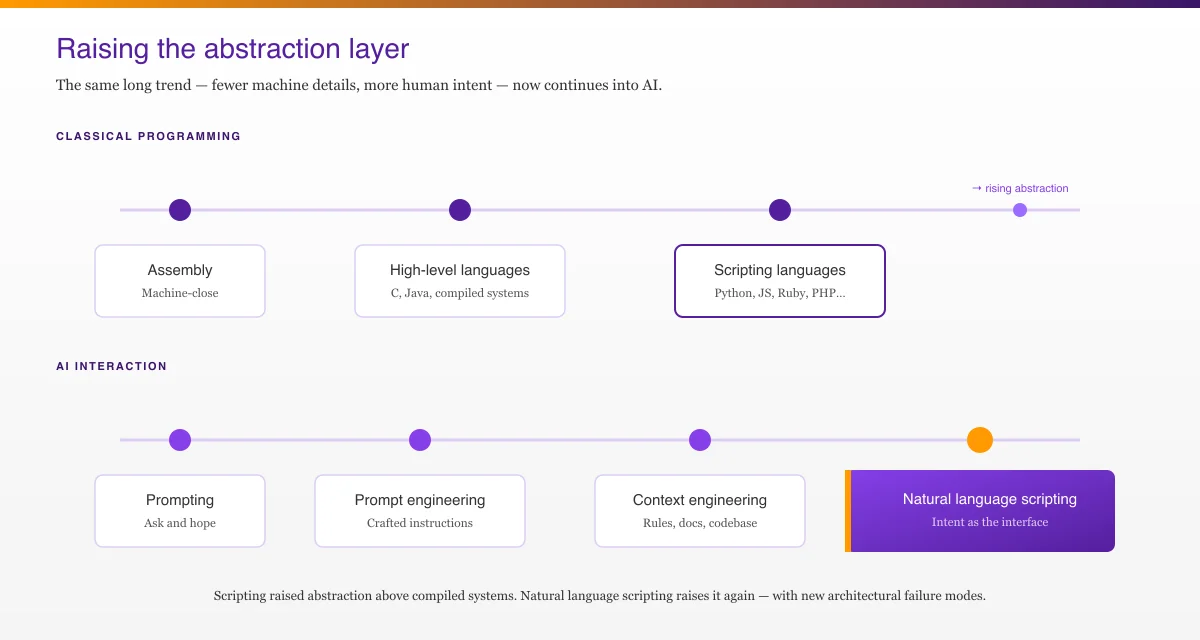
Managing that layer — the design patterns, organisational habits, and harnesses that keep deterministic and non-deterministic outcomes under control — is now part of professional software practice.
Buy the runtime. Own the harness.
Once you accept that natural language is becoming an instruction layer, the next question is practical: do you buy an off-the-shelf AI coding environment, assemble open tooling, or build something custom?
A useful way to think about it is to separate the runtime from the harness. The runtime is the agent loop — the product that edits files, calls tools, shows diffs, and keeps a developer in flow. That market moves quickly. Names change. Features leapfrog each other. A feature-by-feature bake-off published today will be stale before the next quarter closes.
The harness is different. It is the policy and context system wrapped around the runtime: the architecture rules the model must respect, the examples that encode local patterns, the permissions that constrain what an agent may touch, the review gates that catch bad merges, and the evals that tell you whether “works on my machine” means “works for the business.” That layer is closer to your intellectual property than any vendor UI.
| Capability | Usually arrives with a vendor runtime | You should still own |
|---|---|---|
| Agent loop, editor UX, tool calling | Yes | Thin adapters only |
| Architecture rules and domain patterns | Partially, if you write them | Source of truth in the repo |
| Permissions, secrets, blast-radius limits | Some defaults | Policy that matches your risk |
| Human review and CI gates | Rarely complete | Always |
| Eval suites for non-deterministic behaviour | Emerging / uneven | Always, if quality matters |
So the decision is rarely “vendor versus custom” in the absolute. Vendor and open-source harnesses are excellent for speed, onboarding, and day-to-day agency. A fully custom harness only earns its cost when your architecture rules, security posture, or multi-tool reality demand a control plane that no single product will carry for you. Most mature teams land on a hybrid: rent the runtime, own the policy.
Vendor-agnosticism is how you keep that hybrid honest. Put the durable knowledge in portable form — architecture notes, coding standards, golden examples, build and test commands, eval scripts — and keep it in git. Then add thin adapters for whichever tools your developers actually use. Vendor specifics still matter, but as patterns rather than as gospel: some tools concatenate nested rule files; some prefer a single project instruction file; some only honour a portable file when their native file is absent; some scope context by path or glob; some expose stronger permission and sandbox models than others. Those differences affect how you wire the harness. They should not redefine what the harness is.
That ownership mindset extends past rules files into the boring operational truths: which model you called, what it cost, and whether the bill matches the value. We have written separately about building real-time visibility into multi-model spend rather than flying blind behind a single vendor dashboard — see Beyond the Budget: How I Built a Real-Time OpenRouter Cost Tracker.
At Arc2, that is the standard we hold ourselves to. The agent may change. The architecture, the review bar, and the evidence that quality held should not.
Where this is heading
Looking ahead, more capable models and agents will keep reaching smaller businesses. Governance, evaluation, and ethics will move from slide decks into operating procedure. Agentic systems will have to live inside real enterprise workflows, not beside them. Industry-specific solutions will proliferate. Data residency, and the choice between cloud-hosted and self-hosted AI, will become board-level decisions rather than tooling preferences.
That last point fits a longer pattern. IT repeatedly swings between centralisation and decentralisation: mainframes to PCs, on-prem to cloud, monoliths to microservices and back toward modular monoliths. The AI revolution opened with the same move. Capability concentrated in a handful of frontier labs and cloud APIs — centralised intelligence rented by the token.
That concentration is not the end state. The historical pattern points the other way next: more capability moving toward the edge — local models, private inference, self-hosted agents, and infrastructure teams reclaiming control where cloud premiums no longer pay for themselves.
We have already seen frontier practitioners push back on pure cloud dependency. David Heinemeier Hansson and 37signals documented a cloud exit that cut multi-million-dollar AWS run rates by bringing compute, and later storage, onto owned hardware — projected savings of over ten million dollars across five years. That kind of move used to demand scarce ops expertise at every step. AI-assisted host management — provisioning, hardening, migration runbooks, observability, and remediation guided by agents under human review — lowers the operational barrier and makes selective decentralisation practical for more organisations, not only hyperscale-sceptical outliers. Arc2 has walked a version of that path in production: our Sportch technical overhaul moved a live product off a poorly fitting cloud setup onto owned, controllable infrastructure where cost, latency, and operability could be reasoned about directly.
Cloud remains the right default for many workloads. The strategic question is no longer “cloud or not?” but where on the centralisation spectrum each system belongs, and whether your team has the harness to operate either pole safely.
Closing
The AI revolution is not waiting for perfect strategy documents. It is already inside customer journeys, marketing loops, factories, and codebases. Businesses that thrive will not be the ones that adopted every tool first. They will be the ones that chose problems with real value, kept humans accountable for architecture, and built a harness strong enough that speed did not quietly become fragility.
Start where the business hurts. Prove the outcome. Encode the patterns that keep systems coherent. Then let AI multiply the people who still understand what “good” looks like.