
WordPress has dominated the web for nearly two decades. It’s familiar, flexible, and backed by a vast ecosystem. For many organisations, it has become the default choice, often without question.
But default does not mean optimal.
Walk into most web projects in 2026, and someone will suggest WordPress. It’s the path of least resistance. Yet for content-driven websites, marketing sites, documentation, and company homepages, this approach increasingly feels like overkill. Modern static site generators, particularly Hugo, offer something genuinely different: not just faster sites, but a fundamentally simpler architecture that eliminates entire categories of problems before they can exist.
This isn’t about fashion or novelty. It’s about how the web actually works.
The Architectural Difference
To understand why, you need to grasp what happens under the hood when each system handles a page request.
WordPress is a dynamic runtime system. When someone visits your site, that request doesn’t simply fetch a pre-written file. Instead, the web server fires up PHP, queries the database for your content, loads your theme, executes plugin hooks, renders everything on the fly, and sends the result back to the browser. This happens for every single request. It’s remarkable that it works at all, and it works well enough for most sites. But it means every page view involves computation, database access, and multiple layers of code execution. There are optimisation strategies to mitigate these problems of course – e.g. caching – but none the less the result is complexity.
Hugo works in the opposite direction. It’s a compile-time system: a tool you run locally (or in your build pipeline) that takes your content and templates and transforms them into plain static HTML files. No database. No PHP runtime. No plugin hooks. Just files. When someone visits your site, the web server simply serves the pre-built HTML that already exists. The difference is profound: the computational work happens once, when you publish, not repeatedly for every visitor. Once built, your site is a collection of static files (which, ironically, is how the web was originally designed to work).
This architectural distinction cascades into nearly every other advantage Hugo offers. A massive reduction in security surface area. Deterministic, predictable performance. No maintenance treadmill. No compatibility worries. The distinction is noteworthy.
Performance by Default
Here’s a uncomfortable truth about WordPress: performance is something you work towards. You choose the right hosting, install caching plugins, set up a CDN, optimise your database, and then hope for the best. You’re constantly tuning, tweaking, and monitoring. Fast sites don’t emerge from WordPress by accident. They emerge from careful engineering.
Hugo flips this around. Performance is something you start with.
A Hugo site, by its nature, serves pre-rendered HTML with zero server processing. Your visitors get near-instant responses because there’s no runtime overhead, no database queries, no code execution. Just files being served. Scale becomes trivial: throw it on a CDN and watch it handle millions of requests with ease. Every metric that matters (Time To First Byte, rendering speed, overall page load) hits excellent numbers not because of optimisation work, but because of fundamental architecture.
The practical difference is striking. With WordPress, reaching the performance baseline that Hugo provides out of the box typically requires investment in multiple caching layers, careful plugin selection, CDN configuration, and continuous monitoring. Even then, performance remains fragile. A plugin update, a theme change, or a hosting adjustment can undo months of optimisation work. With Hugo, the baseline is unshakeable.
Security Through Simplicity
WordPress is one of the most attacked platforms on the internet. Not because it’s badly built. The WordPress team is competent and security-conscious. Rather, it’s ubiquitous and dynamic, with a massive surface area. Every WordPress site is a potential target, and many use third-party libraries (plugins, themes) that introduce vulnerabilities beyond your control. Sites built on WordPress depend on the security practices of every plugin developer they install.
A Hugo site has virtually no attack surface to speak of. There is no PHP runtime that could be exploited. No database connection that could be compromised. No admin panel, no login form, no server-side code execution. An attacker scanning your site will find nothing but static HTML files. There’s nothing to attack and nothing to exploit.
Security in Hugo doesn’t come from hardening a complex system. It comes from eliminating complexity altogether. You can’t patch a vulnerability in code that doesn’t run. You can’t exploit a database that doesn’t exist. This isn’t security through obscurity; it’s security through simplicity.
Predictability and Stability
WordPress sites have a way of degrading over time. A plugin updates and introduces a regression. A theme update breaks your layout. A PHP version bump creates incompatibilities. Your hosting provider makes a change and performance takes a hit. Small, incremental changes accumulate into frustration: your site isn’t quite what it was last month, and you’re not entirely sure why.
Hugo sites are deterministic. The same source content and templates always produce the same output. If your site builds cleanly today, it will build cleanly in two years. This has practical implications. Version control becomes meaningful. You can review exactly what changed between builds. Rolling back any change is trivial. Reproducing the site on a new machine takes minutes, not hours of debugging. Testing changes safely is straightforward because you’re just dealing with files, not a complex system with hidden dependencies.
This predictability transforms maintenance from an ongoing struggle into almost non-existent work. WordPress sites demand vigilance. You need to monitor updates, test changes, and watch for compatibility issues. Hugo sites, once built and deployed, largely disappear from your concerns. Your content is stored as plain Markdown files (or other text formats), which means it’s portable, future-proof, and not locked into any proprietary format. Years from now, when Hugo is ancient history and the web has moved on, your content will still be sitting there as readable text files.
Content Without Coupling
WordPress tightly couples your content (stored in a database), your presentation (handled by themes), and your runtime logic (plugins). Change your theme and you might break custom functionality. Update a plugin and your content might be affected. This interdependency means content is locked into WordPress; it’s not truly portable.
Hugo separates these concerns cleanly. Your content lives in plain Markdown files. Your templates define how that content should look. The output is just HTML. This clean separation means your content remains independent of your tool. Decide to switch from Hugo to another static generator? Your Markdown files go with you, no migration needed. Think about publishing your content alongside your live site in a simple archive? That works too. Your content is genuinely yours, in a format that any tool can read.
The Maintenance Reality Over Time
Here’s what happens with WordPress: the first month looks great. You spend a weekend setting it up, choose a theme, install a few plugins, and publish your content. Costs seem minimal. Then months pass. Plugin updates accumulate. WordPress itself gets updated. The hosting provider switches datacenter policies. A plugin vulnerability is discovered and patched. You need to test each update. Compatibility issues emerge unexpectedly. Security patches pile up on your to-do list. The site that seemed inexpensive at the start has quietly become a maintenance burden.
Hugo flips the timeline. You invest more effort upfront. You’re building a custom site, after all. The build process might involve learning a new tool. You’re thinking about content structure and templating. But once that initial work is complete, maintenance largely evaporates. There’s no patch treadmill. No plugin ecosystem to babysit. No compatibility worries. No hosting complications. A Hugo site deployed to static hosting can run for years with virtually no attention. Your content updates, but the infrastructure doesn’t need you.
Context Engineering: Taking Hugo Further
At Arc2, we’ve pushed Hugo even further by combining it with what we call context engineering: a deliberate approach to shaping the data that feeds your templates at build time. Rather than letting Hugo do extra work at runtime (or relying on generic themes loaded with conditional logic), we focus on making Hugo’s job simpler and more predictable.
Instead of using generic, feature-heavy themes, we build around a single, flexible, custom template. Combined with strong content conventions and carefully structured front matter, this simplicity delivers two concrete benefits. First, builds are blindingly fast. There’s less conditional logic to evaluate, fewer template branches to process, and fewer surprises. Second, the site is coherent. A single template means consistent behavior across your homepage, service pages, about pages, case studies, and blogs. Additional functionality (contact forms, complex interactions) comes through third-party integrations, keeping the core site static, fast, and secure.
The result feels almost boring in its simplicity: flexible without being fragile, opinionated without being restrictive, fast by design rather than by optimisation.
Perfect Lighthouse Scores: Architecture, Not Luck
The combination of Hugo’s inherent simplicity and careful context engineering produces measurable excellence. Arc2’s Hugo sites consistently achieve perfect 100 scores on all Lighthouse metrics (the standard measure of web quality). Performance, accessibility, best practices, SEO: all perfect.
Our own website (the one you’re reading right now) demonstrates this. It’s not a specially-tuned showcase; it’s a real, functional site running the same approach we recommend to clients.
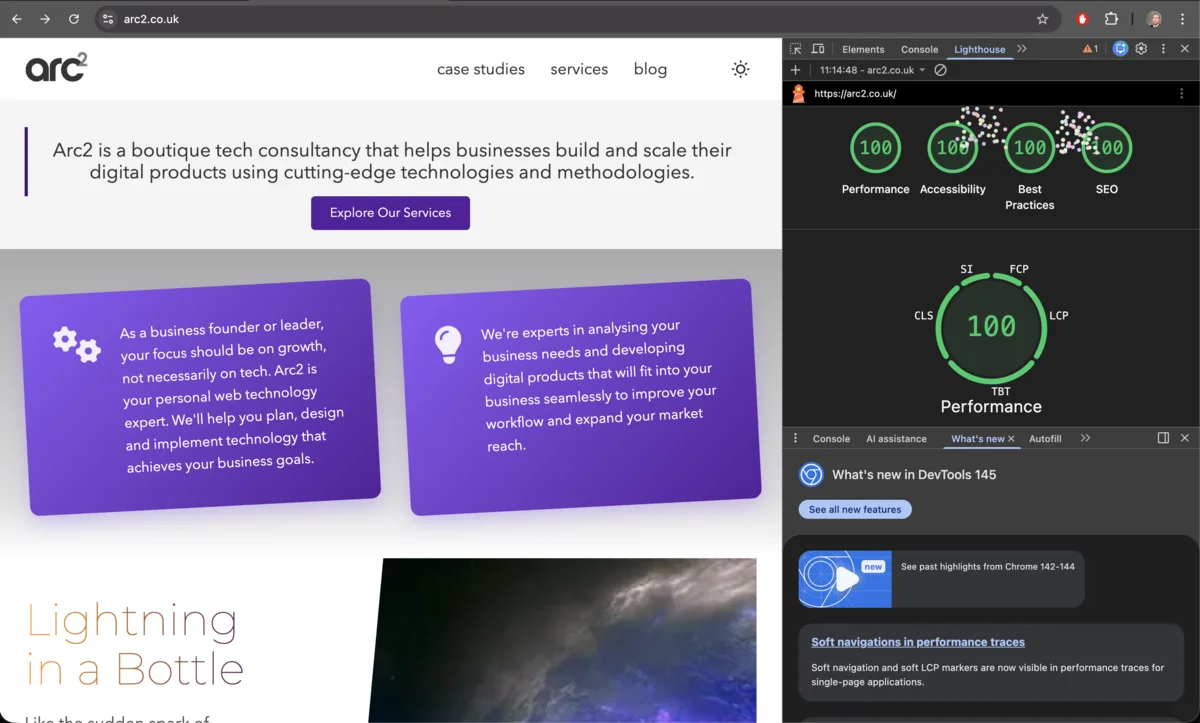
Here’s what’s important: these perfect scores aren’t the result of heroic optimisation work. They’re not the outcome of countless plugins, clever caching strategies, and performance tuning. They’re the natural result of starting with the right architecture.
Static HTML by Default. Hugo generates pre-rendered pages with zero runtime overhead. No JavaScript blocking the paint, no database latency, no server-side rendering delays. Pages arrive already complete.
Minimal Dependencies. A single template means minimal CSS, minimal JavaScript. There’s nothing bloated. The browser parses and renders less, executes less, and gets to show the page sooner.
Optimised Assets at Build Time. Images are automatically resized and converted to modern formats like WebP during the build process. Every asset is compressed appropriately. There’s no room for performance regressions from plugin updates or theme changes because the asset pipeline doesn’t depend on plugins.
Semantic HTML. Clean templates produce semantically correct HTML that browsers parse efficiently and screen readers navigate intuitively. Fast, accessible, correct—not because of effort, but because of structure.
Consistency. Because the site is static, performance is utterly consistent. No cache misses, no slow queries, no variable server response times. Every user gets the same fast experience regardless of traffic volume.
| Aspect | Hugo | WordPress (optimised) |
|---|---|---|
| Performance Setup | Built-in via static HTML | Requires caching layers, plugins, CDN |
| Asset Pipeline | Automated at build time | Runtime optimisation, plugin-dependent |
| Security Updates | None needed (static files) | Continuous (PHP, plugins, themes) |
| Build Consistency | Deterministic (same output always) | Variable (depends on runtime state) |
| Maintenance | Minimal after launch | Ongoing monitoring and updates required |
| Content Portability | Plain text files, fully portable | Database-dependent, expensive exports |
When WordPress Still Makes Sense
This isn’t a “WordPress is always bad” argument. WordPress still excels when you need things Hugo can’t deliver: user-generated content at scale, complex editorial workflows, in-browser content editing for non-technical teams, or heavy runtime interactivity without building custom code. For applications masquerading as websites, WordPress or other dynamic platforms remain the right choice.
The question isn’t “should everyone use Hugo?” It’s “should static generation always be the default assumption?” For most websites—content delivery, speed, security, longevity, and minimal maintenance—Hugo is increasingly the obvious choice.
The Architectural Shift
What’s happening is a quiet architectural shift in how we build websites. For nearly two decades, dynamic CMS platforms were the default because generating static files at scale was cumbersome and version control for content was clunky. Those constraints no longer exist. Modern tooling makes static-first development faster and simpler than ever.
The realization is straightforward: if you don’t need the complexity, why build on it? Why assume every site needs a database, runtime language, plugin system, and ongoing deployment challenges? Start with the simplest possible architecture that solves your actual problem, then add complexity only when you need it.
Hugo (and tools like it) represent this thinking: build once, serve everywhere, remove what you don’t need. At Arc2, we favour Hugo not because it’s trendy—static site generators have been around for a decade—but because it aligns with how the modern web actually works: distributed, global, and ruthlessly simple.
Sometimes the best system is the one that does the least, does it perfectly, and then gets out of your way.